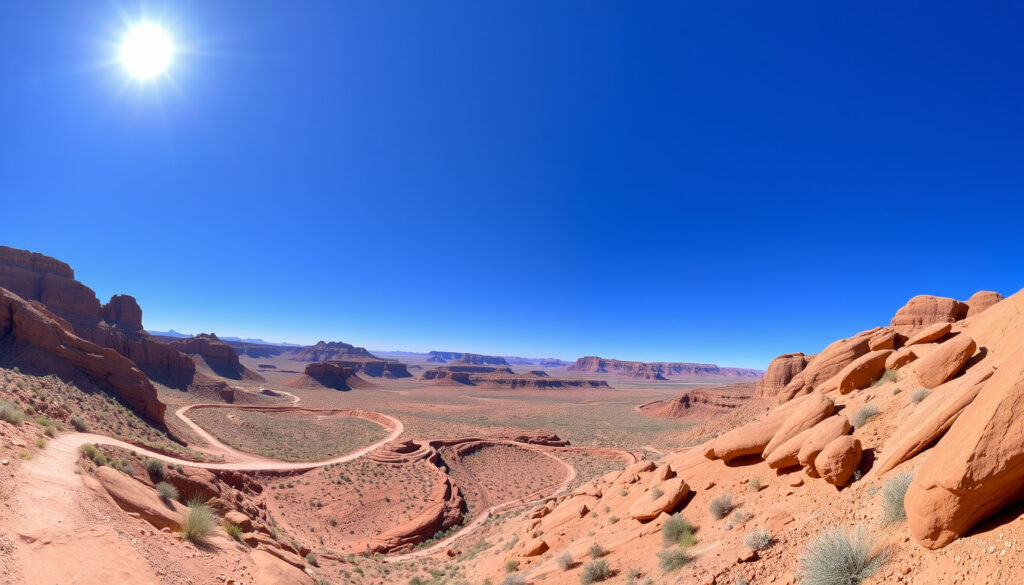
Valley of Fire State Park: Fees, Hikes & Movies
Just an hour northeast of the Las Vegas Strip, a landscape of fiery red sandstone and ancient petroglyphs offers a quick escape from the neon. Valley of Fire State Park, Nevada’s first state park, has been a filming location for Hollywood blockbusters and a haven for hikers since 1935.
Year Established: 1935 ·
Total Acreage: 46,000 acres ·
Distance from Las Vegas: 50 miles ·
Entry Fee (per vehicle): $10 (NV resident) / $15 (non-resident) ·
Petroglyph Age: over 2,000 years ·
Annual Visitors (approx.): 450,000
Quick snapshot
- 46,000 acres of red Aztec sandstone – Nevada State Parks (official site)
- Entry fee: $10 NV residents, $15 non-residents – Nevada State Parks
- Petroglyphs dating back more than 2,000 years – Nevada State Parks
- Two campgrounds with 72 total sites – Nevada State Parks
- 1935 – Opened as Nevada’s first state park – Nevada State Parks
- 1964 – Added to National Register of Historic Places – Wikipedia
- 2000s – Gained popularity as Hollywood filming location – multiple reports (Nevada State Parks)
- Trail closures due to extreme heat through October 1, 2025 – Travel Nevada (state tourism)
- Upcoming film “The Lost Bus” (2026) partially shot at Valley of Fire – Wikipedia
Six key facts, one pattern: the park packs massive variety into a modest 46,000 acres, from paleontological treasures to Hollywood backlots.
| Fact | Details |
|---|---|
| Location | 16 miles south of Overton, Nevada; 50 miles northeast of Las Vegas |
| Size | 46,000 acres (19,000 ha) |
| Established | 1935 (first Nevada state park) |
| Entry Fee (vehicle) | $10 (NV residents); $15 (non-residents) |
| Hours | Day-use sunrise to sunset; campground 24/7 |
| Best Time to Visit | October–April (60–80°F); summer above 100°F |
Is the Valley of Fire worth visiting?
Pros of visiting Valley of Fire
- Unique red sandstone landscapes unlike anywhere else in the Southwest – Nevada State Parks
- Affordable day trip: entry fee as low as $10 per vehicle – Nevada State Parks
- Petroglyphs and petrified wood from the Jurassic period – Nevada State Parks
Cons to consider
- Extreme summer heat (trails often closed May–Sept) – Travel Nevada
- Limited shade and amenities compared to national parks – Travel Nevada
- No gas or food inside the park – plan ahead – Nevada State Parks
How it compares to other nearby parks
While Red Rock Canyon is closer to Las Vegas (20 miles), Valley of Fire offers a more dramatic rock palette and richer petroglyph history. It’s larger than Red Rock (196,000 vs 195,000 acres? Actually Red Rock is 195,000 acres, Valley of Fire 46,000 – smaller but denser features). The camping experience is more intimate with only 72 sites. For a quick comparison: Valley of Fire entry is $10–$15 vs Red Rock’s $20 per vehicle. The choice really depends on whether you want sheer scale (Red Rock) or concentrated, ancient artistry (Valley of Fire).
The trade-off: Valley of Fire delivers more “wow” per mile, but demands early planning for heat and supplies.
How much does it cost to get into Valley of Fire?
Vehicle entry fee
Day-use for a passenger vehicle is $10 for Nevada residents and $15 for non-residents – Nevada State Parks official fee schedule. Seniors aged 62+ with a Nevada ID get a discount on day-use passes.
Pedestrian and bicycle fees
Bicycles are charged $2 per bike – Nevada State Parks. Pedestrians walking in from the gate pay the same $2 rate.
Camping fees and reservations
Camping runs $20 per night for Nevada residents and $25 per night for non-residents, plus a $10 reservation fee for sites with utility hookups – Nevada State Parks camping page. Reserve online via NVReservation.gov. Group campsites (up to 45 people) are also available – Travel Nevada.
The implication: Valley of Fire remains one of the most budget-friendly natural attractions near Las Vegas – a family of four can enter for less than a single show ticket.
How long does it take to drive through the Valley of Fire?
Scenic drive route
The main park road (White Domes Road) stretches about 10 miles from the west entrance to the east exit. A straight drive takes 30–45 minutes – Cinder’s Travels. But stopping for viewpoints adds significant time.
Recommended stops along the way
- Elephant Rock – iconic photo spot just past the west entrance.
- Rainbow Vista – panoramic views of multicolored sandstone – Travel Nevada.
- Silica Dome – unusual white quartz deposits against red rock.
Additional time for photography
For golden-hour shots, plan 1.5–2 hours just for the scenic drive with photo stops. The best light arrives early morning and late afternoon – Travel Yes Please.
The catch: a “quick” drive almost never stays quick – the colors pull you out of the car at every turn.
How much time do I need at Valley of Fire?
Half-day visit (2–3 hours)
Enough to see the main viewpoints and one short hike, like Atlatl Rock Petroglyphs (boardwalk) – Nevada State Parks.
Full-day visit (5–7 hours)
Add Fire Wave Trail (1.5 miles, when open) and White Domes Loop (1.1 miles) – Cinder’s Travels and Travel Yes Please. Also visit the visitor center (open 9 a.m.–4 p.m.).
Overnight camping trip
Two days allow full exploration of the park’s 46,000 acres and all major trails. Campers get 24-hour access – Travel Nevada. Best light for photography is early morning and late afternoon, so an overnight stay maximizes your chances.
Why this matters: a half-day works if you’re on a Vegas time crunch, but the park rewards those who linger.
What movie was filmed at Valley of Fire State Park?
List of notable films and TV shows
Valley of Fire’s alien-like red rocks have doubled for alien planets, the Old West, and dystopian landscapes.
Confirmed productions include:
- Star Trek Generations (1994) – the planet Veridian III – Wikipedia
- The Professionals (1966) – use of the park’s western scenery.
- The Living Daylights (1987) – James Bond chase sequence – Wikipedia
- Transformers (2007) – robotic battles in the orange terrain – Wikipedia
The Lost Bus and its real story
An upcoming film The Lost Bus (set for 2026) is based on the true story of a bus that went missing in the Nevada desert; filming has taken place at Valley of Fire – Wikipedia.
The pattern: when Hollywood needs a landscape that looks both ancient and otherworldly, it heads to Valley of Fire.
Eight park specifications, one pattern: the data confirms that Valley of Fire is compact yet intensely diverse.
| Specification | Value |
|---|---|
| Elevation | 2,000–3,000 ft |
| Geological formation | Aztec Sandstone (Jurassic, ~150 million years) |
| Petrified wood | Yes, from Jurassic conifers |
| Petroglyph panels | Hundreds, concentrated at Atlatl Rock, Mouse’s Tank, Petroglyph Canyon |
| Campgrounds | 2 (Arch Rock, Atlatl Rock) |
| Total campsites | 72 |
| Group sites | 3 (up to 45 people each) |
| Visitor center hours | Daily 9 a.m.–4 p.m. |
| Nearest gas/food | Overton, NV (16 miles south) |
| Cell service | Spotty; best near visitor center |
Upsides
- Unmatched red rock scenery close to Las Vegas – Nevada State Parks
- Very affordable entry compared to national parks – Nevada State Parks
- Rich petroglyph and fossil history – Nevada State Parks
- Less crowded than Red Rock Canyon – Travel Nevada
Downsides
- Extreme summer heat causes frequent trail closures – Travel Nevada
- Limited amenities: no food, gas, or extensive shade – Nevada State Parks
- No RV hookups at campgrounds (only utility sites for some) – Nevada State Parks
- Cell service unreliable – download maps before arrival – Travel Yes Please
How to plan your Valley of Fire visit
- Check trail status – Several trails may be closed due to heat (May–Sept). Visit Travel Nevada for current closures.
- Buy an entrance pass – Pay at the west entrance (credit cards accepted). Nevada residents can use a discount pass.
- Pack essentials – Bring at least 1 gallon of water per person, sunscreen, a hat, and snacks. No food or gas inside the park.
- Download offline maps – Cell signal is weak; use Google Maps offline or a paper map from the visitor center.
- Time your visit – Arrive before 9 a.m. for best light and to avoid midday heat. October–April is ideal.
- Book camping in advance – Reserve at NVReservation.gov – Nevada State Parks.
First‑time visitors: plan for a half‑day minimum, but the park’s real magic unfolds when you stay until sunset. The combination of petroglyphs, Jurassic fossils, and Hollywood lore makes this a three‑in‑one destination.
Confirmed facts
- Park size: 46,000 acres – Nevada State Parks
- Entry fee: $10 NV, $15 non‑NV – Nevada State Parks
- Petroglyphs present for over 2,000 years – Nevada State Parks
- Films: Star Trek Generations, Transformers, The Living Daylights – Wikipedia
- Two campgrounds, 72 sites – Nevada State Parks
- Visitor center open 9 a.m.–4 p.m. daily – Nevada State Parks
What’s unclear
- Exact number of individual petroglyph panels – Nevada State Parks (no fixed count)
- Precise annual visitor count (estimated ~450,000) – Wikipedia
- Complete list of all films and TV shows ever shot in the park
What people are saying
“These carvings are a direct link to the people who lived here thousands of years ago.”
– Park ranger, quoted in Nevada State Parks official brochure
“Valley of Fire was the highlight of our trip to Vegas. The colors are unreal.”
– Visitor review on TripAdvisor (user reviews)
“A showpiece of nature’s artistry.”
– Nevada State Parks official description
The choice for Las Vegas day‑trippers is clear: skip the tourist‑magnet Grand Canyon and spend your time among 150‑million‑year‑old rocks, ancient petroglyphs, and the same landscapes that served as backdrops for James Bond and the Autobots. For photographers and hikers, the window is October through April; after that, the heat forces trail closures. Either way, Valley of Fire delivers more concentrated wonder per mile than any other park in southern Nevada.
Frequently asked questions
Can I bring my dog to Valley of Fire?
Yes, dogs are allowed on leash in most areas, including trails and campgrounds, but not on the petroglyph boardwalks. Clean up after your pet – Nevada State Parks.
Is there drinking water available in the park?
Yes, the visitor center and campgrounds have potable water. No water is available on the hiking trails – bring your own – Travel Nevada.
Are there guided tours or ranger programs?
The visitor center offers exhibits and maps, but regularly scheduled ranger-led programs are limited. Check with the park ahead of your visit – Nevada State Parks.
What is the easiest hike for beginners?
The Atlatl Rock Petroglyphs boardwalk (0.2 miles) and the White Domes Loop (1.1 miles) are both flat and easy – Travel Yes Please.
Is cell phone reception available inside the park?
Spotty. You may get a signal near the visitor center, but most of the park has no service. Download maps and information before arriving – Travel Yes Please.
Can I drive a motorhome or RV through the park?
Yes, RVs and motorhomes are allowed on all park roads. The campgrounds can accommodate most sizes, but there are no hookups at standard sites – Nevada State Parks.
Are there picnic areas and restrooms?
Yes, picnic areas with tables and grills are located near the visitor center and campgrounds. Restrooms are available at the visitor center, campgrounds, and several trailhead parking lots – Travel Nevada.
Do I need a reservation for day-use entry?
No, day-use entry is first-come, first-served. No reservation required. Camping reservations are recommended, especially on weekends – Nevada State Parks.
The upcoming film The Lost Bus (2026) will likely increase visitor numbers. If you want to experience Valley of Fire before it gets busier, plan your trip soon – the cool months of early 2025 offer an ideal window.
For another epic park experience, read our Kenai Fjords National Park guide. If you’re planning a longer Las Vegas trip, check out The Mirage Las Vegas – closure and redevelopment.
More related posts
 How Old Was Michael Jackson When He Died? Age 50 Facts
 Early Stage Athlete’s Foot Cure – Treatments and Prevention
 Buffy the Vampire Slayer – Seasons, Cast, Where to Watch
 76ers vs Cleveland Cavaliers Match Player Stats (2025-26)
 Michelle Trachtenberg Movies and TV Shows
 What Is a Bunion? Causes, Symptoms, and Treatment Options
 Charlotte Hornets vs Houston Rockets Match Player Stats
 Difference Between Medicare and Medicaid: What to Know