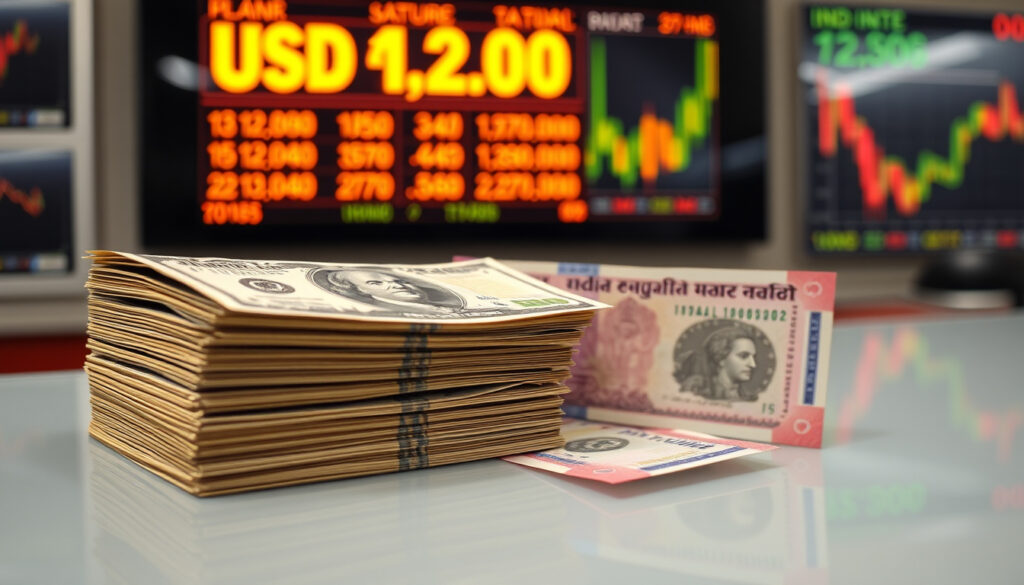
US Dollar to Rupee: Live Exchange Rate & Converter Today
The USD-INR conversation gets real fast when you’re sending money to family in India, planning a trip, or negotiating a salary — and the rate is more than just a number on a screen. The rupee has held a relatively steady range lately, and understanding exactly where the numbers sit can save you real money on your next transfer.
Mid-market rate: 1 USD = ₹93.13 (XE) ·
Yahoo Finance rate: 93.0900 ·
Remitly promo rate: 93.60 INR per USD ·
XE update time: As of 02:00 UTC ·
1-month change: 0.01%
Quick snapshot
- INR future strength trajectory
- Black market rate variations outside official channels
- Transfer fees and promo rates affect what your recipient actually receives (Remitly)
Four data sources converge on nearly identical mid-market rates, confirming the USD-INR baseline for mid-April 2026.
The table below compares live rates across major providers — note that even small percentage differences compound on larger transfers.
| Source | Rate | Notes |
|---|---|---|
| XE mid-market | ₹93.12999404 | Updated 17:57 UTC |
| Wise | ₹93.48 | Mid-market |
| Yahoo Finance | 93.0900 +0.56% | Live quote |
| Ria Money Transfer | ₹92.71764 | Mid-market |
How much is $1000 US dollars in India?
Live rate breakdown
At the XE mid-market rate of 1 USD = ₹93.13, converting $1,000 USD yields approximately ₹93,130 (rounded from the precise 93,129.99). BookMyForex, a licensed Indian exchange service, typically offers rates close to the mid-market benchmark with a small margin built in. That margin means your ₹93,130 mid-market figure may arrive as roughly ₹92,800–₹92,950 in your recipient’s account after fees, depending on the provider and transfer method.
For a $1,000 transfer, the difference between the best rate (₹93,130) and an average bank transfer (potentially ₹92,500) is about ₹630 — enough to cover a week’s groceries for a small family in many Indian cities.
Equivalent buying power
The ₹93,130 generated from $1,000 USD carries significantly more purchasing power in India than the equivalent dollar amount does in the United States. Per Numbeo, a single person in India spends approximately ₹27,483 ($292 at current rates) monthly excluding rent. For a family of four, that figure rises to roughly ₹98,487 ($1,048) excluding housing costs. This means $1,000 USD converts to enough rupees to cover a single person’s monthly expenses for three months, or a family’s baseline costs for nearly a full month.
Remittance recipients in India stretch dollars dramatically further than senders may realize. A $200 monthly support payment from a family member abroad can cover rent in tier-2 cities or fund three weeks of balanced meals for a family.
The pattern is unmistakable: each dollar converts to exceptional purchasing power in India, whether the beneficiary is a recipient relying on remittances or an expat managing local expenses.
How much is $100 US in India today?
Current Revolut rate
Revolut, a London-based neobank, reports a USD to INR conversion rate of approximately ₹88.58 per dollar (with Revolut citing 88.5803 and a 4.91% change noted against some baseline). The discrepancy between Revolut and mid-market rates (₹88.58 vs. ₹93.13) reflects Revolut’s dynamic pricing model, which can include markups, fees, and volume-based adjustments.
At $100 USD, Revolut would yield approximately ₹8,858, while the mid-market rate would generate ₹9,313. That gap of ₹455 per $100 transferred is worth noting if you’re comparing providers for regular payments.
Daily fluctuations
Exchange rates move throughout the trading day based on forex market activity, central bank signals, and global economic sentiment. The Yahoo Finance live rate showed 93.0900 with a 0.56% daily gain as of the most recent update, reflecting modest INR movement. Over a one-month horizon, the rate’s 0.01% change suggests relative stability, though individual transfers at different times of day may show minor variations of 10–30 paise.
Why is the INR falling?
Recent trends
The Indian rupee has faced structural pressure from several directions: high crude oil imports (India imports over 80% of its crude needs, creating sustained USD demand), a widening current account deficit, and capital outflows during periods of global uncertainty. Over recent months, these pressures have kept the INR in a 91–95 range against the dollar.
Global factors
Federal Reserve policy decisions, U.S. Treasury yield movements, and dollar index strength all influence INR’s trajectory. When the Fed signals rate pauses or cuts, emerging market currencies often see brief relief. Conversely, strong U.S. economic data typically strengthens the dollar and pressures INR.
The 0.01% one-month change in the USD-INR rate suggests the pair has settled into a holding pattern, neither gaining nor losing significantly. Analysts note this relative stability may reflect the Reserve Bank of India’s active intervention through forex reserves — India held approximately $650 billion in reserves as of early 2026, giving the central bank ammunition to smooth excessive volatility.
Can you live on $1000 a month in India?
Monthly expenses breakdown
At approximately ₹93,130 per month (the $1,000 USD equivalent), the answer for most Indian cities is a qualified yes — with important caveats. Numbeo estimates monthly costs for a family of four at ₹98,486.70 ($1,047.90) excluding rent. Single-person monthly costs average ₹27,483.20 ($292.40) excluding housing.
Aetna International’s expat guide for 2025-2026 aligns closely: a family of four spends roughly ₹98,910 ($1,095) monthly excluding rent, while a single person budgets ₹27,574 ($305). This suggests $1,000 USD (₹93,130) covers a single person’s baseline expenses comfortably and a family’s costs almost entirely — though metropolitan areas will push against or exceed this threshold.
City variations
The cost-of-living index varies dramatically by city. Mumbai carries India’s highest cost-of-living index at 25.5 (Numbeo, 2026), with average monthly expenses ranging from ₹30,000–₹60,000 per Digit Insurance. Hyderabad offers the highest local purchasing power index at 189.6, meaning salaries stretch further despite moderate living costs of ₹12,000–₹50,000 monthly.
City-level expense comparisons reveal how far $1,000 USD stretches depending on location.
| City | COL Index | Rent Index | Est. Monthly Budget (₹) |
|---|---|---|---|
| Mumbai | 25.5 | 17.5 | 30,000–60,000 |
| Delhi | 22.1 | 7.2 | 20,000–45,000 |
| Bangalore | 21.2 | 10.5 | 20,000–50,000 |
| Pune | 22.1 | 6.5 | 18,000–40,000 |
| Hyderabad | 20.7 | 8.0 | 12,000–50,000 |
| Kolkata | 19.5 | 4.5 | 12,000–30,000 |
Hyderabad combines moderate living costs with the highest purchasing power in India, making it particularly attractive for professionals earning in rupees or receiving partial USD-denominated income. Mumbai, meanwhile, consumes the same $1,000 budget fastest — a ₹93,130 monthly income could feel constraining.
Is 200 rupees a lot of money in India?
Daily spending survey
According to survey data on daily spending patterns, over 80% of Indians spend less than ₹200 ($2.15 at current rates) per day. This figure encompasses all categories — food, transport, utilities, and incidental expenses — for a significant portion of the population. It establishes ₹200 as a modest but functional daily budget, not a poverty-line marker.
Urban vs rural
The urban-rural divide in daily spending is pronounced. In metro cities like Mumbai and Delhi, ₹200 might cover two bus rides and a cheap meal. In tier-2 cities and rural areas, ₹200 can purchase a day’s worth of vegetables, protein, cooking fuel, and public transport. Wise’s April 2025 cost-of-living data reflects this: tier-2 cities like Jaipur and Indore show COL indices of 17–18 compared to Mumbai’s 25.5.
For perspective: a single person in a tier-2 Indian city may budget ₹15,000 monthly (approximately $160), while the same lifestyle in Mumbai requires ₹60,000 ($640). At the Revolut rate of ₹88.58 per dollar, this gap translates to a meaningful difference in actual purchasing power.
Inflation trends in India — particularly food and energy prices — can compress ₹200’s purchasing power within months. Remittance senders should consider that the real value of their transfers may decline even if the nominal INR amount stays the same.
India continues to offer a significantly lower cost of living compared with the UK, U.S., and Australia.
— Aetna International (Expat Healthcare Provider), 2025-2026 Guide
Compared to Western countries, India remains one of the most affordable places to live. Overall living costs are roughly 70–80% lower than the United States or United Kingdom.
— Costoflivingindia.com (COL Tracker), 2026 Data
The pattern is consistent across multiple independent sources: India ranks among the world’s most affordable major economies, with day-to-day costs running 70–80% below U.S. levels for most categories. Groceries cost 73.1% less, transportation 49.8% less, and housing — the biggest expense in Western cities — runs 89.3% less than American equivalents. Restaurants are 82.7% cheaper, according to MyLifeElsewhere’s comparison data.
For USD earners sending money to India, this cost gap means each transferred dollar converts to exceptional purchasing power — benefiting recipients through lower local costs while creating real value for families depending on remittances.
Related reading: Live gold spot prices · S&P 500 live prices
revolut.com, dollar2rupee.net, mylifeelsewhere.com, aetnainternational.com, livingcost.org, westernunion.com, wise.com, godigit.com
Related coverage: US dollar to INR today fördjupar bilden av US Dollar to INR Today: Live USD to INR Exchange Rate.
Frequently asked questions
What is the current 1 USD to INR rate?
The XE mid-market rate stands at approximately ₹93.13 per dollar, with Wise at ₹93.48 and Yahoo Finance at 93.0900. Rates fluctuate throughout the trading day.
How much is $1 USA in India?
At the mid-market rate of ₹93.13, one dollar converts to roughly ₹93.13. Provider-specific rates may range from ₹88.58 (Revolut) to ₹93.60 (Remitly promotional rate on first transfer).
Is INR going to get stronger?
Analysts point to crude oil prices, Federal Reserve policy, and India’s trade balance as key drivers. The one-month change of 0.01% suggests near-term stability, but longer-term direction remains uncertain.
What is US dollar to rupee black market?
Black market rates are difficult to verify reliably and typically show wider deviations from official mid-market rates. We recommend using licensed providers like BookMyForex, Wise, or Remitly for accurate and legal transfers.
What was 1 USD to INR in 1947?
At Indian independence in 1947, the rupee was pegged at approximately ₹3.30 per dollar. The rate has depreciated significantly over the decades to reach today’s ₹93+ range.
Is India struggling financially?
India ranks 192nd out of 197 countries by cost of living, indicating it remains one of the world’s most affordable places. GDP per capita stands at $2,695, with growth driven by services, manufacturing, and technology sectors.
What is euro to INR?
EUR to INR typically trades around ₹101–₹103 per euro, reflecting the dollar-euro cross rate. For current EUR-INR rates, check XE or Wise for live quotes.
What is pound to INR?
GBP to INR typically trades around ₹118–₹122 per pound depending on market conditions. The pound’s higher denomination means each pound buys more rupees than each dollar.
More related posts
 Words That Start with J: Comprehensive List of 550+ J Words
 B&H Photo Video: Trust, Controversy, Pricing & More
 Walmart Supercenter Near Me: Find Locations, Hours, and More
 Mary Makes It Easy Recipes: Best Dishes from Both Shows
 Free Crossword Puzzles Online: Play Daily Without Paying
 Ohio State vs Purdue 2025: Score, Rivalry, Prestige
 Charlotte Hornets vs Houston Rockets Match Player Stats
 English to Haitian Creole: Best Free Translators