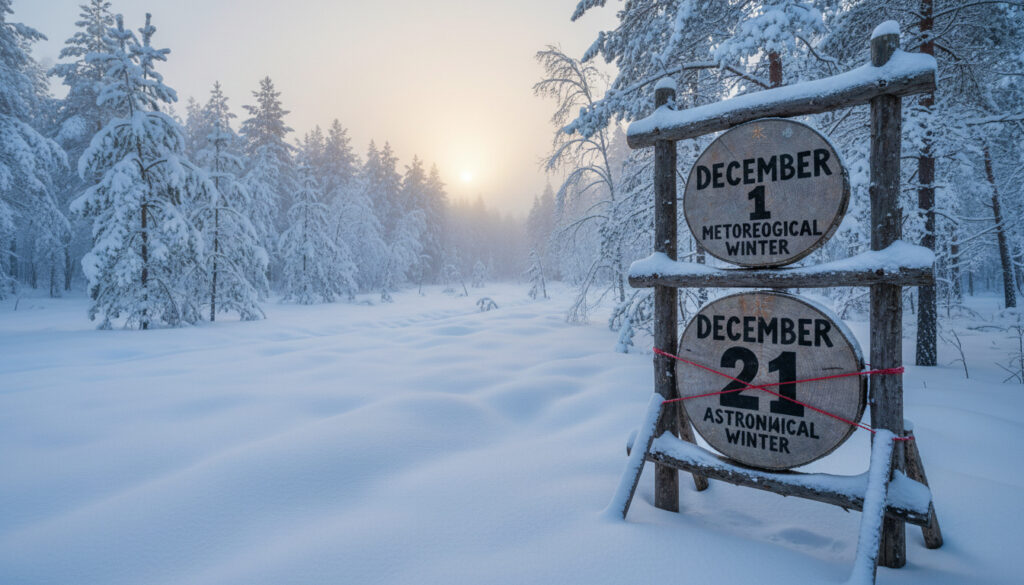
When Does Winter Start – 2025 Dates Astronomical vs Meteorological
The arrival of winter depends entirely on which authority you consult. Astronomers mark the season’s beginning at the precise moment of the winter solstice, when Earth’s axial tilt positions a hemisphere at its maximum distance from the sun. Meteorologists take a different approach, fixing the start to December first in the Northern Hemisphere for statistical consistency. Both definitions carry scientific validity, yet they create parallel timelines that rarely align.
This divergence extends globally. While the Northern Hemisphere approaches the December solstice, the Southern Hemisphere experiences its summer peak. The resulting complexity affects everything from agricultural planning to movie release dates, as industries navigate calendar-based expectations against astronomical reality.
When Does Winter Officially Start?
Official start dates vary by discipline. Astronomical systems track orbital mechanics, while meteorological frameworks prioritize data consistency. The following comparison illustrates how these definitions diverge across hemispheres.
| Metric | Astronomical (Northern) | Meteorological (Northern) | Astronomical (Southern) |
|---|---|---|---|
| Start Date | ~December 21 | December 1 | ~June 21 |
| End Date | ~March 20 | February 28/29 | ~September 22 |
| Duration | 89 days (average) | 90/91 days | 89 days (average) |
| Basis | Solstice position | Fixed calendar | Opposite tilt |
- Solstice dates shift one to two days annually due to Earth’s elliptical orbit and leap year corrections.
- Meteorological winter provides consistent three-month periods for temperature trend analysis.
- The coldest average temperatures typically occur four to six weeks after the solstice, not on it.
- Southern Hemisphere winter directly opposes Northern Hemisphere timing.
- Exact solstice moments vary by time zone, sometimes falling on December 20 or 22.
- Polar regions experience extremelight variations, with some locations entering prolonged darkness.
- Historical records show solstice timing has shifted gradually over centuries due to precession.
| Year | Northern Start (EST) | Southern Start (EDT) | Northern End | Southern End |
|---|---|---|---|---|
| 2024 | Dec 21, 4:20 a.m. (Espace pour la vie) | Jun 20, 15:51 (Espace pour la vie) | Mar 20, 2025 | Sep 22, 2024 |
| 2025 | Dec 21, 10:03 a.m. (Farmer’s Almanac) | Jun 20, 21:42 (Espace pour la vie) | Mar 20, 2026 | Sep 22, 2025 |
| 2026 | Dec 21, 15:49-16:48 (Espace pour la vie) | Jun 21, ~3:25 (Espace pour la vie) | Mar 20, 2027 | Sep 22, 2026 |
Astronomical vs. Meteorological Winter: Key Differences
The Astronomical Definition
Astronomical winter commences at the exact instant of the winter solstice. According to the Space Science and Engineering Center, this occurs when one of Earth’s poles reaches its maximum tilt away from the sun—approximately 23.5 degrees. The result is the shortest period of daylight and the longest night of the year for that hemisphere. Wikipedia’s astronomical records confirm that this timing reverses hemispheres, meaning December’s Northern winter solstice coincides with Southern summer.
The Meteorological Definition
Meteorologists employ fixed calendar dates to maintain consistent statistical baselines. Winter runs December 1 through February 28 (or 29 in leap years) in the Northern Hemisphere, and June 1 through August 31 in the Southern Hemisphere. Espace pour la vie notes that this system ignores solar positioning entirely, focusing instead on temperature record consistency and quarterly climate data compilation.
Meteorological seasons simplify climate trend analysis by ensuring each season contains exactly three months. Astronomical seasons vary between 89 and 93 days due to orbital eccentricity, complicating year-to-year weather comparisons.
Winter Solstice and Annual Start Dates
Northern Hemisphere Precision
For 2025, the Northern Hemisphere winter solstice arrives on . The Farmer’s Almanac calculates this moment as when the sun reaches its lowest apparent altitude at solar noon. The season extends approximately 89 days, concluding at the vernal equinox on March 20, 2025.
Southern Hemisphere Reversal
Southern Hemisphere residents experience winter during the Northern summer solstice. STEMVisions research confirms the 2025 Southern winter begins on June 20 at 21:42 EDT, persisting until the spring equinox on September 22. This six-month offset creates the seasonal opposition that places Australian skiing concurrent with European beach seasons.
Solstice dates shift slightly each year due to the mismatch between the calendar year (365 days) and the tropical year (365.24 days). Leap year corrections prevent the dates from drifting significantly, though exact times may vary by several hours across time zones.
When Does Winter End and Hemisphere Variations?
Astronomical winter terminates at the vernal equinox, when day and night achieve roughly equal duration. Espace pour la vie data places the 2025 Northern spring equinox on March 20, while Southern Hemisphere winter concludes on September 22. Research from the University of Wisconsin indicates that polar regions experience extreme manifestations of this cycle, with locations above the Arctic Circle entering weeks of total darkness.
In extreme northern or southern latitudes, the solstice marks periods of continuous night or civil twilight lasting weeks. Climate data shows Alaska and Antarctic research stations experience “polar night” conditions that extend significantly beyond the solstice date itself.
The National Weather Service clarifies that variation increases with distance from the equator. While tropical regions experience minimal seasonal daylight shifts, higher latitudes see dramatic fluctuations that affect both the perceived start of winter and its meteorological impact.
The Annual Cycle of Winter Beginnings
- June 20-21: Southern Hemisphere astronomical winter begins simultaneously with Northern summer solstice.
- December 1: Northern Hemisphere meteorological winter commences for statistical record-keeping.
- December 21 (typical): Northern Hemisphere astronomical winter arrives at the solstice.
- March 20: Northern winter concludes at the vernal equinox.
- September 22: Southern winter ends with the southern vernal equinox.
Established Facts vs. Variable Elements
| Verified Information | Variable or Uncertain Factors |
|---|---|
| Astronomical winter always begins at the precise moment of the winter solstice. | Exact minute of the solstice shifts annually due to orbital mechanics and leap year calculations. |
| Meteorological winter follows fixed dates: December 1 (North) and June 1 (South). | Climate change may gradually shift perceived seasonal boundaries, though definitions remain fixed. |
| Hemispheres experience opposite seasons simultaneously. | Regional temperature minimums vary by geography, often lagging weeks behind the solstice. |
| The winter solstice marks the shortest daylight period of the year. | Local cloud cover and atmospheric conditions affect actual sunlight received. |
Why Different Definitions Coexist
The dual system emerged from distinct professional needs. Astronomers require precision tied to Earth’s orientation in space, ensuring that seasonal markers correspond with solar geometry. This alignment matters for calculations regarding solar energy, navigation, and celestial observation.
Meteorologists developed fixed-date seasons to facilitate consistent statistical comparison. Weather stations need three-month intervals that align with calendar months to compute reliable climate normals and temperature averages. The Old Farmer’s Almanac notes that this system eliminates the confusion of shifting solstice dates when comparing December 2024 temperatures against December 2025 data.
Sources and Scientific Authority
“Astronomical seasons begin at the exact moment of solstices and equinoxes, when Earth’s axial tilt relative to the Sun is at its extreme.”
— Space Science and Engineering Center
“The winter solstice marks the start of astronomical winter: shortest daylight and longest night in that hemisphere, as one pole tilts maximally away from the Sun.”
— Farmer’s Almanac
Key Takeaways on Winter’s Arrival
Winter arrives twice annually for different purposes: astronomically at the solstice and meteorologically at the calendar turn. For 2025, Northern Hemisphere residents will mark December 21 at 10:03 a.m. EST as the astronomical start, while Southern Hemisphere observers await June 20. Understanding both definitions clarifies seasonal planning, from agricultural cycles to Labor Day 2025 dates that signal summer’s meteorological end.
Common Questions About Winter’s Beginning
What are the winter months?
Meteorologically, winter encompasses December, January, and February in the Northern Hemisphere, and June, July, and August in the Southern Hemisphere. Astronomically, the months vary yearly but center on the solstice period.
Does winter always start on December 21?
No. While common, the winter solstice can occur on December 20, 21, 22, or 23 depending on the year and time zone. Meteorological winter always begins December 1.
Is the winter solstice the coldest day?
No. The coldest temperatures typically arrive in January or February in the Northern Hemisphere due to thermal lag. Earth’s surface and oceans continue cooling weeks after receiving minimum solar input.
Which definition do weather apps use?
Most weather services reference meteorological seasons for statistical reporting, but may note astronomical dates for cultural events. Forecasting models rely on the consistent three-month meteorological framework.
Why do Australia and America have opposite winters?
Earth’s 23.5-degree axial tilt positions one hemisphere toward the sun while the other faces away. When the Northern Hemisphere tilts toward the sun (June), the Southern Hemisphere tilts away, creating opposite seasons.
When does winter end in 2025?
Astronomical winter ends March 20, 2025, at the vernal equinox. Meteorological winter ends February 28, 2025.
Can both hemispheres experience winter simultaneously?
No. The axial tilt mechanism ensures that when one hemisphere experiences winter solstice, the other experiences summer solstice. Both hemispheres never share the same season simultaneously.
More related posts
 The Phoenician Scheme Reviews: Booed at Cannes
 Reheat Pizza in Oven: Best Temps, Times & Crispy Tips
 How Old Is Rory McIlroy? Age, Wife, Kids & Net Worth 2025
 Difference Between Medicare and Medicaid: What to Know
 Best Mexican Food Near Me in Dublin: Top Picks
 What Is a 504 Plan? Definition, Accommodations, and How It Works
 Did Kim Kardashian Pass the Bar? Her Law Career Timeline