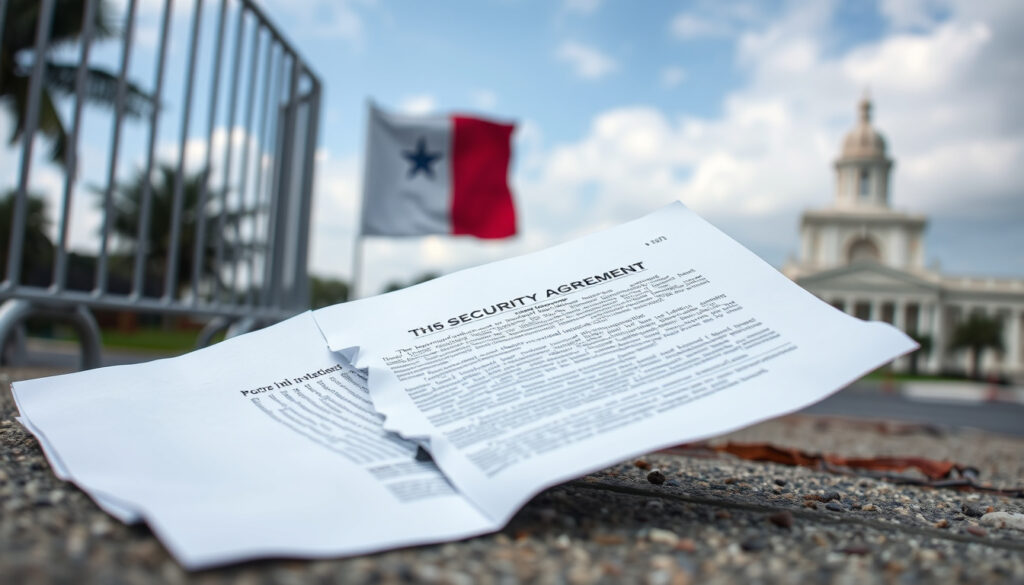
Panama Security Agreement Protests: Mulino Faces Backlash
Panama’s latest security pact with the US has reignited deep-seated sovereignty fears that date back decades. President José Raúl Mulino signed the agreement on May 8, 2025, triggering widespread protests.
Date of Agreement: May 8, 2025 ·
President: José Raúl Mulino ·
Protesters: Hundreds of university students and teachers ·
Key Issue: US military access to Panama Canal area ·
Duration of Protests: Ongoing since early May 2025 ·
Stated Stance of Mulino: Will not renegotiate the agreement
Quick snapshot
- Security agreement signed on May 8, 2025 (CSIS (security policy think tank))
- Mulino refuses to renegotiate (The Washington Times (US news outlet))
- Protests involve teachers and students (Jamaica Observer / AFP (international news agency))
- Total number of protesters across multiple demonstrations
- Long-term impact on US-Panama relations
- Whether the agreement has been ratified by Panamanian legislature
- Exact details of the joint operations centers
- What the Supreme Court will rule on the constitutional challenge
- Teachers strike began April 23, 2025 (Prensa Latina English (state news agency))
- Security pact signed during US Defense Secretary visit April 2025 (The Tico Times (Costa Rica-based news))
- Supreme Court challenge to agreement filed April 16 (The Tico Times)
- Mulino says he will not renegotiate (The Washington Times)
The implication: the sovereignty concerns that drove the 1989 invasion and the 1999 Canal transfer are back in the spotlight.
| Field | Value |
|---|---|
| President | José Raúl Mulino (since July 2024) |
| Date of Security Pact | May 8, 2025 |
| Main Protest Groups | Teachers union, university students |
| Number of Protesters | Hundreds (exact figure not available) |
| US Military Access Details | Memorandum allowing US troops to operate in Panama Canal region |
| Panama Canal Owner | Panama (since December 31, 1999) |
Are there protests in Panama right now?
Why are people protesting?
- Thousands demonstrated in Panama City on May 6, 2025, in the biggest rally in three weeks of strikes (Jamaica Observer / AFP (international news agency)).
- The protests began as a teachers’ strike in late April and expanded after the security agreement was signed (Green Left (activist publication)).
- Demonstrators also oppose a pension reform law (Law 462) and plans to reopen a large copper mine (Newsroom Panama (Panama-based news)).
What is the security agreement with the US?
- The memorandum of understanding, signed in April 2025, allows US military personnel to operate at three Panamanian facilities: Panama Pacífico, Naval Base Balboa, and Aeronaval Base Cristóbal (CSIS (security policy think tank)).
- Critics say it creates joint operations centers and grants cost-neutral passage for US warships through the Canal (Americas Quarterly (Latin America analysis)).
- A citizens’ coalition has asked the Supreme Court to declare the agreement unconstitutional, citing six articles of the constitution (The Tico Times (Costa Rica-based news)).
Who is President José Raúl Mulino?
- Mulino, a center-right conservative, took office in July 2024 after serving as vice president under Laurentino Cortizo.
- He has stated he will not renegotiate the security deal (The Washington Times (US news outlet)).
- His administration is criticized by left-leaning groups for neoliberal policies and alignment with US interests.
The pattern: each side is entrenched, and no resolution appears imminent.
Is Panama a US ally now?
History of US-Panama relations
- Panama has been a key US ally in Central America, especially after the 1989 invasion that removed Manuel Noriega (Jamaica Observer / AFP).
- Relations have been shaped by the 1977 Torrijos-Carter treaties, which set the Canal transfer process.
- The 2025 security pact is the latest in a series of defense agreements, but critics argue it undermines the sovereignty gained in 1999.
Current military cooperation agreement
- The agreement was signed during US Defense Secretary Pete Hegseth’s visit in April 2025 (The Tico Times).
- Some reporting links the deal to pressure from former President Donald Trump’s threats over the canal (World Socialist Web Site (Marxist analysis)).
- Panama retains full ownership of the Canal, but the agreement allows US military operations near it.
Panama is officially a US ally, but the alliance is now being tested by the very people it is meant to protect. The protesters see the deal not as cooperation, but as a return to the era of US domination.
The catch: the alliance’s legitimacy is now in question among those it is supposed to serve.
What country owns the Panama Canal right now?
Panama Canal transfer in 1999
- Panama has owned and operated the Canal since December 31, 1999, after the Torrijos-Carter treaties were fully implemented.
- The transfer was a landmark moment for Panamanian sovereignty, ending nearly a century of US control.
Impact of US military access on Canal sovereignty
- The 2025 agreement does not change ownership, but it permits US military personnel to operate at bases adjacent to the Canal (CSIS).
- Protesters argue this effectively compromises the spirit of the 1999 handover.
- One analyst noted the deal gives US warships cost-neutral passage through the Canal (Americas Quarterly).
For Panamanians, the Canal is the ultimate symbol of self-determination. Allowing US military access near it — even without changing ownership — feels like a step backward. The constitutional challenge filed by citizens is a direct attempt to halt that drift.
What this means: the spirit of the 1999 handover is contested, even as the legal ownership remains unchanged.
Which president removed Manuel Noriega?
Operation Just Cause (1989)
- President George H.W. Bush ordered the invasion of Panama in December 1989, code-named Operation Just Cause (Jamaica Observer / AFP).
- The stated goals were to protect US lives, restore democracy, and bring Noriega to justice on drug trafficking charges.
George H.W. Bush’s role
- Noriega was captured in January 1990 and brought to the US for trial, where he was convicted and sentenced to 40 years.
- The invasion remains a deeply sensitive event in Panama. Many see it as an example of US willingness to use military force to secure its interests in the Canal region.
- The current protests draw a direct line from that intervention to the new security agreement.
The implications: historical grievances are not distant memory but fuel for today’s mobilization.
Is Panama left or right wing?
Current government under Mulino
- President José Raúl Mulino leads a center-right government, with a focus on business-friendly policies and close ties to the United States.
- His administration has pursued neoliberal economic reforms, including pension reform (Law 462) that sparked part of the labor unrest (Newsroom Panama).
Political leanings of recent administrations
- Panama’s political landscape has shifted between center-left and center-right parties over the past decades.
- Under Mulino, the country is leaning right, but the protest movement includes left-leaning unions, student groups, and civil society.
- The current polarization means the security agreement has become a proxy for a broader ideological battle over Panama’s direction.
The consequence: the agreement has become a flashpoint for broader ideological conflict.
Timeline
- December 1989 – January 1990: US invasion (Operation Just Cause) removes Manuel Noriega.
- December 31, 1999: Panama gains full control of the Panama Canal.
- April 2025: US Defense Secretary Pete Hegseth visits Panama; security agreement signed (The Tico Times).
- April 23, 2025: Public sector teachers begin indefinite strike (Prensa Latina English).
- May 6, 2025: Thousands demonstrate in Panama City — largest protest in three weeks (Jamaica Observer / AFP).
- May 8, 2025: Mulino signs memorandum, refuses to renegotiate (The Washington Times).
- Mid-May 2025: Protests continue; constitutional challenge pending.
The Supreme Court ruling on the agreement’s constitutionality could determine whether the protests escalate or subside. If the court upholds it, Mulino may face even larger demonstrations.
The pattern: the judicial decision will be a decisive factor in the trajectory of the movement.
Confirmed facts vs. What’s unclear
Confirmed facts
- Security agreement signed on May 8, 2025 (CSIS)
- Mulino refuses to renegotiate (The Washington Times)
- Protests involve teachers and students (Jamaica Observer / AFP)
- US military access is near the Panama Canal (CSIS)
- Panama owns the Canal since 1999
What’s unclear
- Total number of protesters across multiple demonstrations
- Long-term impact on US-Panama relations
- Whether the agreement has been ratified by Panamanian legislature
- Exact details of the joint operations centers
The takeaway: the known facts are solid, but key unknowns could shift the narrative.
Quotes from the ground
“I will not renegotiate the agreement. The deal is done.”
— President José Raúl Mulino, as reported by The Washington Times (US news outlet)
“Mulino is sacrificing our sovereignty. We will not allow Panama to become a US military base again.”
— University student protest leader, cited in Jamaica Observer / AFP (international news agency)
“The agreement creates joint operations centers and grants US warships cost-neutral passage through the Canal. That is a direct attack on our sovereignty.”
— Americas Quarterly analysis, Americas Quarterly (Latin America analysis)
“The strike is not just about the security pact. It’s about pensions, the mine, and the direction of the country.”
— Union leader José Cambra, quoted in Green Left (activist publication)
The protests in Panama are not a single-issue outburst. They are the convergence of long-standing grievances over sovereignty, economic inequality, and the legacy of US intervention. For President Mulino, the choice is between holding firm on the security deal — and risking a broader crisis — or opening a renegotiation that could weaken his stance with Washington. For Panamanian protesters, the implication is clear: accept the agreement as a fait accompli, or keep pushing until the government concedes.
Related reading: José Raúl Mulino says he won’t renegotiate Panama security deal with US despite protests · Panama’s protests test President Mulino on multiple fronts
greenleft.org.au, armyrecognition.com, ticotimes.net, peoplesdispatch.org
The ongoing strikes over US military access near the Canal are detailed in Panama security agreement protests.
Frequently asked questions
When did the Panama protests start?
Teachers began an indefinite strike on April 23, 2025. Student-led protests against the US security agreement escalated in early May (Prensa Latina English).
What is the teachers strike about?
Teachers are protesting the US security agreement, pension reform (Law 462), and plans to reopen a copper mine (Newsroom Panama).
How did the US respond to the protests?
The US has not publicly criticized the protests. The agreement was signed by Defense Secretary Pete Hegseth during his April visit, and the Pentagon has not commented on the domestic reaction (The Tico Times).
What are the key terms of the US-Panama security pact?
The MOU allows US military personnel to operate at Panama Pacífico, Naval Base Balboa, and Aeronaval Base Cristóbal for training, exercises, and other activities. It also includes cost-neutral passage for US warships through the Canal (CSIS).
Is the Panama Canal affected by the agreement?
Ownership remains with Panama, but the agreement permits US military operations at bases adjacent to the Canal, which protesters argue undermines sovereignty (Americas Quarterly).
What is President Mulino’s political background?
Mulino is a center-right conservative who served as vice president under Laurentino Cortizo. He took office in July 2024.
How many people died under Manuel Noriega?
Estimates vary. The US invasion and Noriega’s regime are associated with hundreds of deaths, but exact figures are disputed. The UN and human rights groups have documented abuses during his rule.
Are there other recent protests in Panama?
Yes, Panama has seen periodic protests over pensions, mining, and corruption. The current movement is the largest since the 2023 protests against the Minera Panama contract.
More related posts
 Alvin and the Chipmunks: Characters, Girlfriends, Streaming
 Piper Perabo Movies and TV Shows – Complete Filmography Guide
 Grab the Mic Game: Rules, Fun, and Where to Buy (2025)
 Justice Department Expands Efforts Against American Bar Association
 2024 Federal Tax Bracket : Rate , Thre hold & Calculator Guide
 The Serpent and the Wings of Night: Spice & Guide
 According to Jim Cast: Why Cheryl and Dana Left and More
 Best Mexican Food Near Me in Dublin: Top Picks