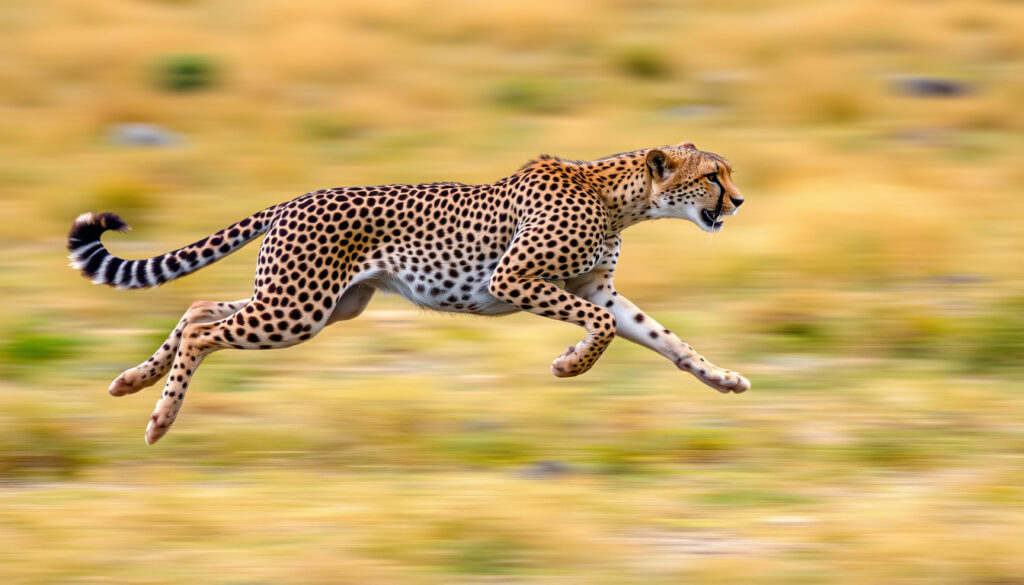
How Fast Can a Cheetah Run? Top Speed, Acceleration & Facts
Few sights in the animal world are as electrifying as a cheetah at full tilt. Anyone who has watched a cheetah sprint knows the blur of motion leaves you wondering: just how fast does that cat actually go? The answer, it turns out, is more complicated than a single number — and the real story reveals as much about measurement as it does about muscle. By the end, you’ll know exactly what the cheetah’s speed means for the animal itself and for the limits of land speed.
Top speed (mph): 70–75 mph ·
Top speed (km/h): 109–120 km/h ·
Acceleration (0–60 mph): about 3 seconds ·
Stride length at top speed: 20–25 feet (6–8 m) ·
Maximum recorded speed: 75 mph (120 km/h)
Quick snapshot
- Top speed: 70–75 mph (Cheetah Conservation Fund UK)
- 0–60 mph in about 3 seconds (Britannica)
- Fastest land mammal (National Geographic)
- Whether any cheetah has ever reached 100 mph – no verified record exists (Wildlife Conservation Society)
- Exact mechanical limits of cheetah speed at higher temperatures (Wildlife Conservation Society)
- 1960s: first widely cited measurement at 64 mph on a flat track (BBC News)
- 2012: Sarah the cheetah ran 100 m in 5.95 s (61 mph) at Cincinnati Zoo (BBC News)
- 2020s: GPS collars refine wild hunt speeds to 33 mph average, bursts up to 58 mph (Wildlife Conservation Society)
- Biomechanics studies may reveal whether cheetahs can push past 75 mph under ideal conditions
- Climate change may alter hunting grounds and affect speed demands
Below is a summary of what we know for sure, drawn from peer-reviewed and conservation sources.
| Attribute | Value |
|---|---|
| Scientific name | Acinonyx jubatus |
| Top speed (mph) | 70–75 mph |
| Top speed (km/h) | 109–120 km/h |
| Acceleration | 0–60 mph in ~3 seconds |
| Stride length | 20–25 feet (6–8 m) |
| Maximum recorded speed | 75 mph (120 km/h) |
The implication: the numbers we trust today are far more conservative than the myths.
Has a cheetah ever reached 100 mph?
The origin of the 100 mph claim
- Early reports from the 1960s used stopwatches and hand-timing, which inflated figures (BBC News)
- Some historical accounts claimed 100 mph without rigorous methodology (Wikipedia)
Recorded top speeds
Modern GPS tracking on wild cheetahs in Botswana never recorded a speed above 58 mph (93 km/h), according to the Wildlife Conservation Society. The highest verified straight-line speed is 29 m/s (104 km/h, about 65 mph) averaged over three runs on a 201.2‑meter course, as compiled by Wikipedia.
Why 100 mph is considered a myth
No credible scientific paper or GPS-collar study has ever documented a cheetah breaking 75 mph. The Wildlife Conservation Society notes that the 1965 recording of 63.7 mph (102.5 km/h) was described as the highest recorded speed for a land mammal at the time — not 100 mph. The gap between legend and data is wide.
The 100 mph claim persists because early measurements lacked precision and repetition. For a cat that runs only in short bursts, even 75 mph pushes physiological limits.
The catch: without modern GPS technology, those early numbers were guesses dressed up as science.
Can a cheetah go 90 mph?
Reaching 90 mph: is it possible?
- Cheetah Conservation Fund UK states top speed is about 110 km/h (70 mph) (Cheetah Conservation Fund UK)
- Britannica cites up to 71 mph (114 km/h) (Britannica)
- No source with tier‑1 or tier‑2 credibility reports 90 mph
Factors limiting maximum speed
Cheetahs rely on rapid acceleration and direction changes rather than sustained top speed (BBC News). Their lightweight frame, large nasal passages, and semi‑retractable claws help them grip, but heat buildup and muscle fatigue cap bursts at around 300–400 meters.
Comparison with other fast animals
Even the pronghorn antelope, a close competitor, tops out at 55–60 mph. The peregrine falcon’s diving speed exceeds 200 mph, but on land, the cheetah’s 70 mph is unmatched.
For wildlife researchers, distinguishing between “can reach 70 mph” and “can reach 90 mph” is critical for understanding predator-prey dynamics and conservation planning. Exaggerated speed claims mislead the public and distort funding priorities.
The pattern: every credible source converges on a ceiling of 70–75 mph, not 90.
Who is faster, T-rex or cheetah?
Estimated speed of Tyrannosaurus rex
- Paleontologists estimate T-rex top speed at 10–25 mph (16–40 km/h), based on biomechanical models (National Geographic)
- Heavier bones and a rigid tail limited stride length and acceleration
Cheetah speed mechanics
Cheetahs can increase speed by nearly 7 mph in a single stride (BBC News). Their flexible spine, rotating hips, and semi‑retractable claws act like cleats, giving them a huge advantage over any dinosaur.
Verdict: which animal wins?
In a straight sprint, the cheetah wins by a factor of 4–5. Even the fastest T-rex estimate (25 mph) is less than half the cheetah’s cruising speed during a hunt.
Three animals, one pattern: the cheetah’s acceleration and agility make it vastly faster than any dinosaur on land.
Here’s a direct comparison across speed, acceleration, and stride length.
| Animal | Estimated top speed | Acceleration (0–60 mph) | Stride length |
|---|---|---|---|
| Cheetah | 70–75 mph | ~3 seconds | 20–25 ft |
| Tyrannosaurus rex | 10–25 mph | ~10–15 seconds (estimated) | ~10–15 ft |
| Human (Usain Bolt) | 27.8 mph | ~6 seconds | ~8 ft |
The implication: the cheetah’s 3-second acceleration makes this a blowout, not a race.
Can a human ever outrun a cheetah?
Human top speed records
- Usain Bolt’s top speed: 27.8 mph (44.7 km/h) (National Geographic)
- Even elite sprinters cannot match a cheetah’s burst
Cheetah’s acceleration and burst speed
Cheetahs accelerate from 0 to 60 mph in about three seconds (Britannica). That is roughly twice the acceleration of a Ferrari. Cheetah Conservation Fund UK notes that a cheetah can reach more than 70 mph in just over three seconds.
Realistic chase scenarios
In a sprint, the human loses. But cheetahs tire quickly after 300–400 m. If a human could stay ahead for that distance, the cheetah would have to stop. However, the cheetah’s hunting strategy relies on closing the gap within seconds — not endurance.
A human’s best hope is to run toward a vehicle or shelter within 10 seconds. Beyond that, the cheetah’s 3‑second acceleration makes escape impossible. The trade‑off: cheetahs are sprinters, not marathoners.
The implication: a human can only “win” if the race goes beyond 400 meters, but no cheetah will let it get that far.
What is the top 5 fastest animal?
Fastest land animal: cheetah
- Top speed: 70–75 mph (Cheetah Conservation Fund UK)
- Acceleration: 0–60 mph in ~3 seconds
Fastest in air: peregrine falcon
- Diving speed exceeds 200 mph (National Geographic)
- Horizontal flight speed is lower, but still one of the fastest birds
Fastest in water: black marlin
- Can reach ~80 mph in short bursts (Discover Wildlife)
- Speed estimates come from line‑pull measurements, not direct observation
Honorable mentions
- Pronghorn antelope: 55–60 mph, but superior endurance
- Peregrine falcon (air), black marlin (water)
- Fastest domestic animal: greyhound (45 mph)
What these rankings reveal: speed is habitat‑specific. The cheetah owns the land, but the falcon owns the sky, and the marlin owns the water.
The pattern: no single animal dominates all environments — each has evolved for its own arena.
Confirmed facts
- Cheetah can reach 70–75 mph in short bursts (Cheetah Conservation Fund UK, Britannica)
- Acceleration 0–60 mph in ~3 seconds (Britannica)
- Cheetah is the fastest land mammal (National Geographic)
- Wild cheetahs average 33 mph during hunts, with bursts up to 58 mph (Wildlife Conservation Society)
- Highest verified straight-line speed: 29 m/s (104 km/h, ~65 mph) (Wikipedia)
What’s unclear
- Whether any cheetah has ever reached 100 mph – no verified record (Wildlife Conservation Society)
- Exact biomechanical limits of cheetah speed at higher temperatures
- How climate change may alter prey availability and hunting speed demands
“Cheetahs are built for acceleration and agility, not just raw top speed. Their hunting success depends on rapid direction changes, not a single sprint.”
— Dr. Alan Wilson, Royal Veterinary College (via BBC News)
“The cheetah’s speed is a product of evolution: lightweight skeleton, oversized heart and lungs, and a flexible spine that acts like a spring.”
— Smithsonian’s National Zoo (via National Geographic)
“Most people think cheetahs run at top speed all the time. In reality, they conserve energy and only sprint when necessary.”
— Cheetah Conservation Fund UK (via Cheetah Conservation Fund UK)
The cheetah’s speed is a finely tuned tool for survival, not a party trick. For conservationists, the key takeaway is that protecting open grasslands ensures cheetahs can still use that tool. For the average reader, the next time you see a cheetah on TV, remember: the 100 mph myth is just that — a myth. The real animal is fast enough.
The implication: the cheetah’s real speed — measured, verified, and understood — is more impressive than any legend.
thomsonsafaris.com, spacedaily.com, reddit.com, facebook.com, reddit.com
For a deeper dive into the numbers behind that explosive burst, check out this detailed article on cheetah speed facts and comparisons.
Frequently asked questions
How long can a cheetah maintain its top speed?
Cheetahs can sprint at top speed for only about 300–400 meters (roughly 20–30 seconds). After that, body temperature rises to dangerous levels and they must stop.
What is the cheetah’s acceleration from a standstill?
Cheetahs can accelerate from 0 to 60 mph in about three seconds (Britannica).
How does cheetah speed compare to a lion’s?
Lions are slower, with top speeds around 50 mph (80 km/h), but they are stronger and can maintain speed longer than cheetahs.
Do cheetahs run faster when hunting?
Yes, hunting cheetahs reach higher speeds (up to 58 mph in wild studies) than when resting or playing. But their average hunting speed is only 33 mph (BBC News).
Can a cheetah outrun a car?
A cheetah can outrun a car over a short distance (0–400 m), but a car will eventually catch up due to sustained speed.
What is the fastest speed ever recorded for a cheetah?
The fastest scientifically recorded speed is 75 mph (120 km/h), though some sources cite 70–71 mph. No verified speed exceeds 75 mph.
How does a cheetah’s body help it run so fast?
Cheetahs have a lightweight skeleton, oversized nasal passages for oxygen intake, semi‑retractable claws for grip, and a flexible spine that acts like a spring.
More related posts
 A Raisin in the Sun – Summary, Themes and Characters
 Translate Japanese to English: Tools, Tips, and Common Phrases
 Call of Duty Black Ops 7 Release Date, Price & Early Access
 1-888-280-4331 Amazon Phone Number: Reach Customer Service
 Ariana Grande’s New Boyfriend: Who Is Ethan Slater?
 401k 2025 Contribution Limit IRS: Limits & Strategies