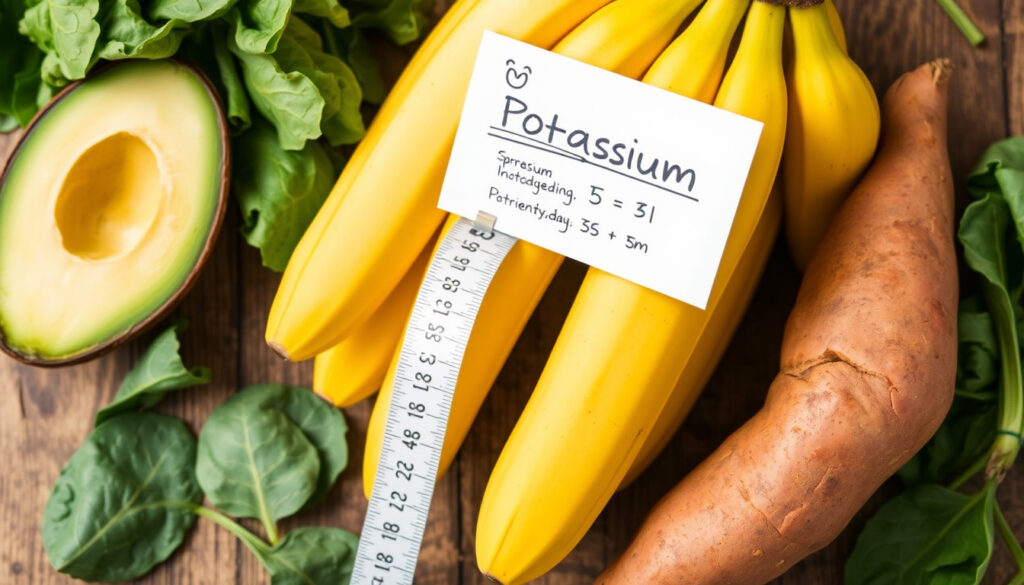
How Much Potassium in a Banana? Daily Needs & Top Sources
Bananas are often touted as a potassium powerhouse, but one medium fruit delivers only 451 mg. That’s a modest 7% of your daily needs.
Potassium in 1 medium banana (Cleveland Clinic): 451 mg ·
Daily value for adult men (Harvard Health): 3,400 mg ·
Daily value for adult women (Harvard Health): 2,600 mg ·
Banana weight per medium fruit (USDA): 118 g ·
Percent DV from one medium banana (Healthline): 7%
Quick snapshot
- 1 medium banana: ~451 mg potassium (Cleveland Clinic (leading U.S. hospital system))
- 7% of daily value for average adult (Cleveland Clinic (leading U.S. hospital system))
- Moderate source, not top (Cleveland Clinic (leading U.S. hospital system))
- Potato (baked with skin): ~941 mg (NIH Office of Dietary Supplements (U.S. federal research agency))
- Avocado: ~975 mg per fruit (NIH Office of Dietary Supplements)
- Spinach (cooked): ~839 mg per cup (NIH Office of Dietary Supplements)
- Men: 3,400 mg per day (Harvard Health (Harvard Medical School’s health publication))
- Women: 2,600 mg per day (Harvard Health (Harvard Medical School’s health publication))
- 4,700 mg for some health conditions (Harvard Health (Harvard Medical School’s health publication))
- Fatigue and muscle weakness (National Kidney Foundation)
- Cramps and palpitations (National Kidney Foundation)
- Seek medical attention if severe (National Kidney Foundation)
Here are the key numbers for quick reference.
| Label | Value |
|---|---|
| Potassium in 1 medium banana (Cleveland Clinic) | 451 mg |
| Potassium in 100g banana (USDA) | 358 mg |
| Daily value (DV) for adult men (Harvard Health) | 3,400 mg |
| Daily value (DV) for adult women (Harvard Health) | 2,600 mg |
| Percent DV from one banana (Healthline) | 7% |
| Potassium in a banana peel (estimated) | 5–10 mg per gram |
How Much Potassium Is in a Banana?
Potassium content per medium banana
One medium banana (118 grams) delivers about 451 mg of potassium, according to Cleveland Clinic (a leading U.S. hospital system). Harvard Health (Harvard Medical School’s health publication) and the NIH Office of Dietary Supplements (U.S. federal research agency) both report 422 mg for the same serving. The variation stems from differences in banana size and ripeness.
Potassium per 100g banana
Per 100 grams, a banana contains roughly 358 mg of potassium (NIH Office of Dietary Supplements). That’s a moderate density – compare it to baked potato flesh at 610 mg per 100g from the same source.
Potassium in a banana compared to daily value
The U.S. Food and Drug Administration sets the Daily Value (DV) for potassium at 4,700 mg for adults and children age 4 and older (FDA (U.S. food regulatory agency) guidance). A single medium banana therefore covers about 9% of that DV using the 422 mg figure, or about 6% using the 451 mg figure – a moderate contribution, not a heavy-hitter.
The implication: bananas are a helpful but not dominant source of potassium.
Is 2 Bananas a Day Enough Potassium?
Daily potassium needs for men and women
For adult men, the adequate intake (AI) is 3,400 mg per day; for women, it’s 2,600 mg, per Harvard Health (Harvard Medical School’s health publication). Cleveland Clinic (a leading U.S. hospital system) notes these figures don’t account for individual factors like height, weight, or activity level.
Contribution of two bananas to daily requirement
Two medium bananas provide roughly 840–902 mg of potassium. That’s about 25% of the men’s AI and 32% of the women’s AI. So two bananas alone are insufficient – you’d need to eat about 8 bananas to meet a man’s daily need, which is impractical and would spike sugar intake.
What to pair with bananas to meet 100%
To reach your daily target, combine bananas with higher-potassium foods. A baked potato with skin (941 mg), a cup of cooked spinach (839 mg), an avocado (975 mg), and a cup of milk (382 mg) easily push you past 3,400 mg. The NIH Office of Dietary Supplements (U.S. federal research agency) provides a comprehensive food table for planning.
The pattern: you need a variety of sources to meet daily targets.
What Is the Highest Potassium Food?
Top potassium-rich foods ranked
Several foods far surpass bananas. According to the NIH Office of Dietary Supplements (U.S. federal research agency) food table, the highest sources include:
- Baked potato with skin – 941 mg per medium potato
- Dried apricots – 755 mg per ½ cup
- Lentils, cooked – 731 mg per cup
- Orange juice – 496 mg per cup
- Avocado – 975 mg per whole fruit
Potato, spinach, avocado, banana comparison
A medium baked potato with skin delivers more than double the potassium of a banana (941 mg vs. 451 mg). One cup of cooked spinach (839 mg) and a whole avocado (975 mg) also outrank the fruit. Bananas sit in the middle of the pack – decent, but not elite.
How to incorporate high-potassium foods daily
Add a baked potato to lunch, toss spinach into dinner, snack on dried apricots or an avocado. Mixing and matching three to four of these foods across meals easily meets the 3,400–4,700 mg target.
Bananas are a convenient, moderate source of potassium – but if you’re serious about hitting your daily target, potatoes, spinach, and avocados are far more efficient per serving.
What this means: for maximum potassium per bite, choose vegetables and legumes over bananas.
How Can I Get 4700 mg of Potassium a Day?
Meal plan examples to reach 4700 mg
The FDA’s Daily Value of 4,700 mg is the target used on Nutrition Facts labels. Reaching it requires deliberate choices. The NIH Office of Dietary Supplements (U.S. federal research agency) confirms that white beans, potatoes, and greens are powerhouses.
Sample daily menu with potassium counts
Try this menu (totals approximate):
- Breakfast: 1 banana (451 mg) + 1 cup milk (382 mg) = 833 mg
- Lunch: 1 medium baked potato with skin (941 mg) + 1 cup cooked spinach (839 mg) = 1,780 mg
- Snack: 1 avocado (975 mg) = 975 mg
- Dinner: 1 cup cooked white beans (1,189 mg) = 1,189 mg
- Total: ~4,777 mg
That menu hits the 4,700 mg target without supplements. Bananas contribute only 451 mg of that total – less than 10%.
Foods to avoid that are low in potassium
Processed meats, white bread, pasta, and sugary snacks are low in potassium. If you’re trying to boost intake, focus on whole plant foods.
The pattern: Reaching 4,700 mg is achievable with a plant-forward diet, but it takes planning – one banana alone won’t get you there.
Are Eggs Very High in Potassium?
Potassium content in eggs
One large egg contains about 63 mg of potassium, per USDA data. Eggs are not a significant source of this mineral.
Comparison of egg potassium to banana
A banana provides roughly 7 times the potassium of an egg (451 mg vs. 63 mg). If you’re relying on eggs for potassium, you’d need to eat about 7 large eggs to match one banana.
Better sources than eggs for potassium
Leafy greens, potatoes, legumes, and avocados are far superior. For those looking to increase potassium, eggs are a poor choice.
The takeaway: eggs are not a potassium source to count on.
What Are the Warning Signs of Low Potassium?
Symptoms of hypokalemia
Low potassium (hypokalemia) can cause weakness, fatigue, muscle cramps, and heart palpitations. The National Kidney Foundation (U.S. kidney health authority) notes that foods with 200 mg or more per serving are considered high-potassium, and bananas easily qualify.
Causes of potassium deficiency
Common causes include diuretic use, heavy sweating, vomiting, diarrhea, and a diet low in fruits and vegetables. Athletes and people on certain medications are at higher risk.
When to seek medical attention
Severe hypokalemia requires medical evaluation. Potassium supplements can be dangerous if taken without medical supervision – always consult a doctor first.
If you experience persistent muscle cramps, fatigue, or an irregular heartbeat, don’t self-treat with potassium pills – get a blood test to confirm deficiency.
The catch: self-diagnosis of low potassium is risky; professional testing is the only safe route.
Why Do Some Doctors Say Not to Eat Bananas?
Bananas and high potassium in kidney disease
People with chronic kidney disease (CKD) have difficulty excreting excess potassium. The National Kidney Foundation (U.S. kidney health authority) advises that foods with more than 200 mg per serving – including bananas – may need to be limited in advanced CKD.
Bananas and blood sugar concerns
Bananas contain natural sugars (about 14 g per medium fruit). People with diabetes may need to monitor portion sizes, especially with ripe bananas that have a higher glycemic index.
Who should limit banana intake
Besides those with CKD or diabetes, individuals with a latex allergy may experience cross-reactivity with bananas. Otherwise, for most healthy people, bananas are perfectly safe and nutritious.
For healthy adults, bananas are a fine potassium source. For those with kidney disease or blood sugar concerns, the same fruit can be problematic – context matters.
The pattern: bananas are safe for most, but individual health conditions change the calculus.
Confirmed Facts vs. What’s Unclear
Confirmed facts
- One medium banana contains about 451 mg potassium (Cleveland Clinic)
- Adult men need 3,400 mg; women need 2,600 mg per day (Harvard Health)
- Potatoes, spinach, avocados have higher potassium content than bananas (NIH)
- Low potassium symptoms include weakness, cramps, palpitations (National Kidney Foundation)
What’s unclear
- Exact potassium content varies by banana size and ripeness
- Benefit of banana peel consumption is under-researched
- Impact of cooking methods on potassium retention is not fully quantified
Expert Perspectives on Potassium and Bananas
“Bananas are well-known for potassium, but they’re not the top source. Many other foods – like potatoes, spinach, and avocados – pack more potassium per serving.”
— Cleveland Clinic nutrition writer, Cleveland Clinic (leading U.S. hospital system)
“The key is variety. Relying on one or two foods for potassium will leave you short. Aim for a mix of vegetables, fruits, legumes, and dairy.”
— Harvard Health editorial, Harvard Health (Harvard Medical School’s health publication)
“If you think bananas are the gold standard for potassium, you’ll be surprised to learn that a baked potato, a cup of spinach, or an avocado all deliver more.”
— EatingWell article, EatingWell (nutrition-focused media outlet)
Comparison Table: Potassium in Common Foods
Six foods, one pattern: several options deliver more potassium per serving than a banana.
| Food | Serving Size | Potassium (mg) | % DV (based on 4,700 mg) |
|---|---|---|---|
| Banana, medium | 118 g | 451 | 9.6% |
| Baked potato with skin | 1 medium (173 g) | 941 | 20% |
| Avocado | 1 whole (200 g) | 975 | 20.7% |
| Spinach, cooked | 1 cup (180 g) | 839 | 17.8% |
| White beans, cooked | 1 cup (179 g) | 1,189 | 25.3% |
| Orange juice | 1 cup (248 g) | 496 | 10.6% |
The implication: Bananas are a convenient, moderate source – but if you’re optimizing for potassium per serving, reach for a potato, avocado, or beans.
Summary: What This Means for Your Diet
Bananas are a decent, portable source of potassium, but they’re not a heavyweight. For the average healthy adult, one banana covers about 7–9% of the daily target. To meet your full requirement – whether 2,600 mg, 3,400 mg, or 4,700 mg – you need a varied diet rich in vegetables, legumes, and potatoes. For the person grabbing a banana on the way out the door, the choice is clear: keep the banana as a snack, but pair it with a spinach salad or a baked potato later in the day, or risk falling short of your potassium needs.
Related reading: How Much Weight Can You Lose in a Month? Safe Rates
drugs.com, healthdirect.gov.au, healthline.com, goodrx.com, myhealth.alberta.ca, kitchen.kidneyfund.org, ods.od.nih.gov
For a detailed breakdown of banana potassium, including comparisons with other fruits, check out this comprehensive guide.
Frequently asked questions
How much potassium is in a banana compared to an apple?
A medium apple contains about 195 mg of potassium – less than half of a banana’s 451 mg. The NIH food table confirms apples are a lower-potassium fruit.
How much potassium in a potato compared to a banana?
A medium baked potato with skin delivers about 941 mg of potassium, more than double the 451 mg in a banana. The NIH Office of Dietary Supplements lists potato as a top source.
Can eating too many bananas cause high potassium?
For healthy people, it’s extremely difficult to reach dangerous potassium levels from bananas alone – you’d need to eat dozens a day. However, those with kidney disease should monitor intake, as the National Kidney Foundation advises.
What drinks are high in potassium?
Orange juice (496 mg per cup), tomato juice (534 mg per cup), and coconut water (about 600 mg per cup) are high-potassium drinks. The NIH includes orange juice in its food table.
How much potassium is in a banana in mEq?
Potassium in milliequivalents: 1 mEq = 39 mg. A banana with 451 mg provides about 11.6 mEq of potassium.
Do bananas lose potassium when cooked?
Cooking can leach some potassium into water, but exact retention rates are not well quantified. The NIH notes that boiling vegetables may reduce potassium content, but data on bananas is limited.
Are green bananas lower in potassium than ripe ones?
Ripeness slightly affects potassium content – green bananas may have slightly less, but the difference is minor. The Cleveland Clinic uses the same 451 mg figure for a medium banana regardless of ripeness.
More related posts
 Nicole Kidman Movies and TV Shows: Complete List
 The Mirage Las Vegas – Closure and Redevelopment Guide
 How Old Was Michael Jackson When He Died? Age 50 Facts
 Ohio State vs Purdue 2025: Score, Rivalry, Prestige
 Make a Word with The e Letter : Un cramble & Find Word Fa t
 Michelle Trachtenberg Movies and TV Shows
 Best Bluetooth Car Adapters 2025: Android & iPhone Picks
 What Is the Price of Gold – Live Spot Prices and Market Trends