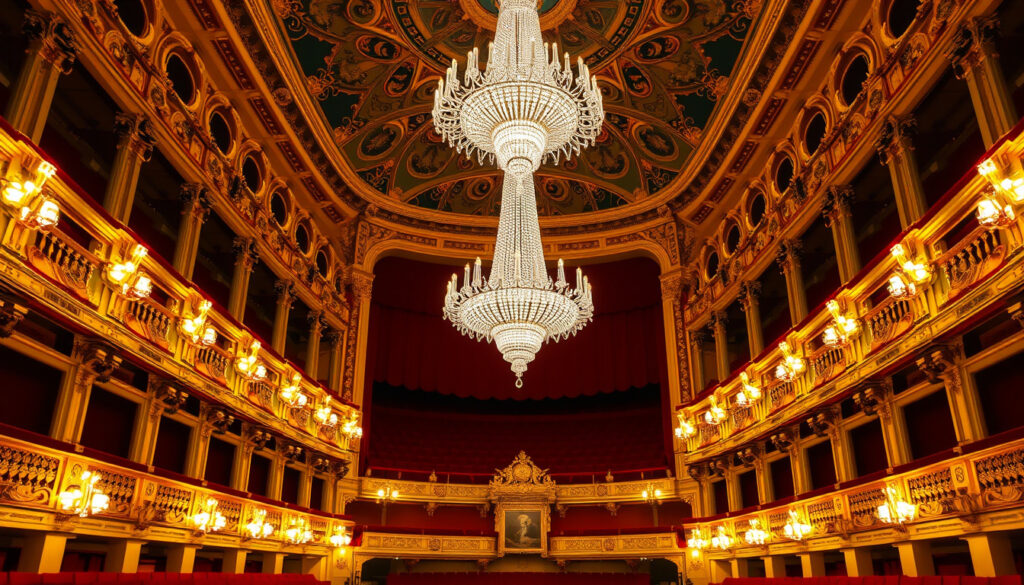
The Phantom of the Opera (2004 Film) – Cast, Plot and Reception
The Phantom of the Opera (2004) stands as one of the most visually ambitious musical adaptations ever brought to the screen. Directed by Joel Schumacher and produced by Andrew Lloyd Webber, the film brought Webber’s beloved stage phenomenon to cinematic life after nearly two decades of development. Starring Gerard Butler as the masked tormentor, Emmy Rossum as the soprano Christine Daaé, and Patrick Wilson as her aristocratic suitor Raoul, the production attempted to translate the grandeur of the original London and Broadway productions into a visual spectacle that theater audiences had never seen before.
The film arrived in theaters on December 22, 2004, carrying enormous expectations from devoted fans of the musical and musical theater enthusiasts worldwide. With a production history stretching back to 1989, when the project was first announced, the adaptation underwent numerous delays before finally reaching cameras in 2002. The result represented a significant financial investment, with a reported budget of $70 million, and aimed to capture both the romantic tragedy and gothic drama that had made the stage version a cultural touchstone since its 1986 premiere.
Is The Phantom of the Opera (2004) a Good Movie?
Joel Schumacher
Gerard Butler, Emmy Rossum, Patrick Wilson
143 minutes
$70 million / $154 million
Key Insights
- The film received mixed reviews, with praise for its visual spectacle but criticism of vocal performances, particularly Butler’s singing
- Despite grossing $154 million worldwide, the film underperformed expectations given the massive popularity of the stage musical
- Three Academy Award nominations acknowledged achievements in cinematography, art direction, and the original song “Learn to Be Lonely”
- The production marked the first major screen adaptation of Andrew Lloyd Webber’s record-breaking musical
- Filming took place entirely at Pinewood Studios using a combination of miniatures and CGI to recreate the Paris Opera House
- The film closely follows the stage musical’s plot while adding visual context for the Phantom’s backstory
Quick Facts
| Fact | Value |
|---|---|
| Release Date | December 22, 2004 |
| Genre | Musical / Romance / Drama |
| Rotten Tomatoes | 33% Critics / 63% Audience |
| IMDb Rating | 7.4/10 |
| Academy Award Nominations | 3 (no wins) |
| Based On | Gaston Leroux’s 1910 novel |
The critical consensus acknowledged the film’s visual grandeur while noting vocal inconsistencies. The decision to cast Gerard Butler, who had no prior professional singing experience and took only four voice lessons before his audition, became one of the most debated aspects of the production.
Who Stars in The Phantom of the Opera (2004)?
Primary Cast Members
The central trio driving the film’s narrative comprises Gerard Butler as the Phantom, Emmy Rossum as Christine Daaé, and Patrick Wilson as Raoul de Chagny. Butler’s casting proved controversial from the outset, as he lacked formal vocal training and reportedly took only four voice lessons before his audition. Director Joel Schumacher reportedly saw Butler in Dracula 2000 and envisioned a “rock and roll” Phantom, a vision that shaped much of the film’s tonal approach. Emmy Rossum, who had studied opera and ballet at the American Ballet Theatre and modeled her performance after dancers Suzanne Farrell and George Balanchine, was not the production’s first choice for Christine. Both Katie Holmes and Anne Hathaway were considered before Rossum secured the role. Patrick Wilson, with his Broadway experience in Cabaret and The Full Monty, brought legitimate musical theater credentials to the role of Raoul.
Supporting Performers
Miranda Richardson portrayed Madame Giry, the opera house’s mysterious box keeper who serves as the Phantom’s protector and the sole character who knows his true origins. The role gave Richardson significantly more depth than her stage counterpart, as the film expands the backstory of how she rescued the young Phantom from a freak show. Minnie Driver took on the role of Carlotta Giudicelli, the diva whose jealousy drives much of the early conflict. Driver’s singing voice was provided by Margaret Preece, and her performance was notably theatrical, described as campy and over-the-top. Simon Callow and Ciarán Hinds played the opera managers André and Firmin respectively, with Hinds notably having no singing experience and being dubbed in his few musical moments.
Other notable cast members include Victor McGuire and Jennifer Ellison in supporting roles, while Ramin Karimloo, who would later become famous playing the Phantom on stage, makes a brief appearance as the portrait of Gustave Daaé, Christine’s deceased father.
What Is the Plot of The Phantom of the Opera (2004)?
The Story Unfolds
Set in the Paris Opera House during the 1870s, the film introduces Christine Daaé as a young chorus girl with extraordinary hidden talent. The disfigured Phantom, a musical genius who haunts the opera house’s depths, has been secretly tutoring Christine, and now forces the managers to install her as their lead soprano. The opera’s new owners, André and Firmin, reluctantly comply while also dealing with their prima donna Carlotta’s fury at being demoted.
As Christine’s star rises, she encounters Vicomte Raoul de Chagny, an old childhood friend who recognizes her voice from a performance and becomes romantically smitten. Their growing relationship provokes intense jealousy from the Phantom, who demands that Christine remain devoted to him alone. The tension culminates at the pair’s engagement ball, where the Phantom crashes the celebration in a dramatic display of supernatural terror, dramatically lowering the massive chandelier and declaring his intentions.
The Phantom’s Backstory Revealed
Madame Giry holds the key to the Phantom’s mysterious past. She reveals to Raoul and the audience that the Phantom began his life as an abused boy displayed in a freak show, rescued by Giry and brought to the opera house where his extraordinary intellect and musical gift flourished in secret. This expanded backstory, which goes beyond what the stage musical depicts, provides additional context for the Phantom’s twisted psychology and desperate need for love and recognition.
The Climax and Resolution
The Phantom forces the managers to stage his own opera, Don Juan Triumphant, as the setting for his final confrontation with Christine. During the performance, Christine removes his mask in defiance, exposing his horrific deformity to the horrified audience. Chaos erupts as the chandelier crashes down and fire spreads through the theater. The Phantom abducts Christine to his underground lair, where he offers her an impossible choice: remain with him and be his, or release her to Raoul, whom Madame Giry has guided to their location.
A mob led by the police and opera workers storms the Phantom’s domain. Meg Giry steals his mask, stripping away his final defense. In a moment of compassion, Christine kisses the Phantom, showing him the love he has craved throughout his tormented existence. This act enables the Phantom to release Christine and Raoul, choosing to flee alone into the shadows while relinquishing Christine’s engagement ring. The scene concludes with a music box playing “Learn to Be Lonely,” Webber’s new song written specifically for the film’s ending.
How Does the 2004 Film Compare to the Stage Musical?
Visual Translation
The most immediately apparent difference between the film and the stage production lies in the visual scope. The stage version, constrained by theatrical limitations, presents the Phantom’s world through lighting effects, set pieces that rotate and transform, and the audience’s imagination. Schumacher’s adaptation, shot at Pinewood Studios, employed extensive miniatures and computer-generated imagery to construct an opulent recreation of a 19th-century Parisian opera house, complete with underground lakes, candlelit corridors, and the famous phantom’s lair beneath the stage.
The film utilizes camera movements and editing techniques impossible in theater, providing close-up access to performers and sweeping shots that reveal the scope of the production design. Where the stage Phantom’s face remains hidden in shadow or revealed only through lighting tricks, the film shows the deformity directly and repeatedly, a choice that some viewers found more disturbing while others appreciated its honesty.
Musical Adjustments
Several musical numbers were trimmed or adjusted to accommodate Butler’s limited vocal range. The production also added “Learn to Be Lonely,” performed over the film’s closing moments, which received an Academy Award nomination for Best Original Song. The stage version concludes with a more ambiguous ending, while the film provides additional closure through Christine’s compassionate kiss and the music box’s melancholy refrain.
The film’s treatment of the Phantom’s backstory through Madame Giry’s revelations offers additional emotional depth not present in the original production, though the core narrative and most musical numbers remain faithful to the stage source material.
The adaptation was announced in 1989 but stalled for over a decade due to Andrew Lloyd Webber’s divorce and Joel Schumacher’s commitment to directing other films, including several Batman productions. Casting finally began in 2002, with filming proceeding at Pinewood Studios where production teams built elaborate sets combining practical construction with digital enhancement.
Where Can You Watch The Phantom of the Opera (2004)?
Current streaming availability for The Phantom of the Opera (2004) varies as platforms rotate their content libraries. The film has historically appeared on services like Max, Amazon Prime Video, and Netflix in various regions, typically available for rental or purchase in digital formats. Availability may differ based on geographic location, and subscription services regularly update their offerings.
Physical media options, including DVD and Blu-ray releases, remain available through major retailers and can provide the highest quality presentation for home viewing. The film’s cult following has maintained interest in various home video editions over the years.
For the most accurate current streaming information, checking platforms directly is recommended, as rights agreements and catalog offerings change frequently. Regional variations mean availability may differ significantly depending on location.
The Road to the Screen: A Production Timeline
- 1910: Gaston Leroux publishes the novel Le Fantôme de l’Opéra, establishing the foundational story
- 1986: Andrew Lloyd Webber’s stage musical premieres in London’s West End, eventually becoming one of the longest-running shows in theater history
- 1989: Production of a film adaptation is first announced, beginning years of development discussions
- Early 2000s: Delays caused by Webber’s divorce and Schumacher’s schedule postpone the project indefinitely
- 2002: Casting begins in earnest; Gerard Butler selected as the Phantom after Schumacher sees him in Dracula 2000
- December 22, 2004: The film opens in theaters across the United States
- 2005: The film receives three Academy Award nominations at the 77th Oscars, including Best Cinematography, Best Art Direction, and Best Original Song for “Learn to Be Lonely”
- 2024 onward: Periodic streaming revivals and anniversary re-evaluations emerge as a new generation discovers the adaptation
What We Know for Certain and What Remains Unclear
| Established Information | Information That Remains Unclear |
|---|---|
| Budget: $70 million | Precise domestic vs. international box office breakdown |
| Worldwide gross: $154 million | Actual production costs including marketing expenses |
| Three Oscar nominations, no wins | Whether specific scenes were reshot or modified after test screenings |
| Butler had no formal vocal training | The full extent of behind-the-scenes creative disagreements |
| Filmed entirely at Pinewood Studios | Why exactly Holmes and Hathaway departed the Christine casting process |
| Rotten Tomatoes scores: 33% critics, 63% audience | Long-term cultural impact assessments remain ongoing |
The Cultural Context and Lasting Impact
The Phantom of the Opera occupies an unusual position in musical theater and cinematic history. The stage production it adapts remains one of the most successful musicals ever staged, having run continuously in London’s West End since 1986 and on Broadway for nearly 18 years. This legacy created impossibly high expectations for any film adaptation, as generations of devoted fans held deeply personal connections to the stage version.
Schumacher’s direction prioritized visual spectacle, embracing an aesthetic that some critics described as excessive or overwhelming. The production design and cinematography received genuine acclaim, earning the film two of its three Oscar nominations. However, the debate over Butler’s vocal performance became the focal point for much of the critical discussion, potentially overshadowing other aspects of the production.
The film’s commercial performance, while seemingly healthy in absolute terms, fell significantly short of projections for a property with the Phantom’s cultural weight. This disconnect between investment and return influenced how studios approached large-scale musical adaptations for years afterward, contributing to a cautious approach to bringing Broadway hits to the screen. Those interested in exploring how other beloved properties have transitioned between media formats may find our coverage of Buffy the Vampire Slayer – Seasons, Cast, Where to Watch offers comparable insights into adaptation challenges.
“Visually stunning but vocally strained.”
— Roger Ebert’s assessment of the film’s divided reception
Sources and Further Reading
The primary sources for information about the 2004 film adaptation include the comprehensive entry on Wikipedia, which documents production history, cast details, and critical reception. The Rotten Tomatoes aggregate provides overview scores from both critics and audiences, while IMDb offers user ratings and additional cast information. Box office performance data can be found through Box Office Mojo, and details regarding the Academy Award nominations are available at the official Oscars website. The TV Guide cast listing provides additional context for the ensemble performance.
Summary: The Phantom of the Opera (2004) in Perspective
The 2004 film adaptation of The Phantom of the Opera represents a ambitious but imperfect translation of Andrew Lloyd Webber’s theatrical phenomenon to the cinema. While the production succeeded visually, earning recognition from the Academy and providing audiences with unprecedented access to the Phantom’s world, it faced significant challenges that limited its critical and commercial achievement. The casting of Gerard Butler, though defensible from a dramatic standpoint, created vocal limitations that permeated discussions of the film. The movie remains available for viewing through various platforms and continues to attract viewers curious about both the stage phenomenon and this particular interpretation of Leroux’s gothic romance.
For those interested in comparing different media treatments of the story, exploring the relationship between stage and screen adaptations offers valuable insights into the challenges of bringing theatrical experiences to cinematic form. Those curious about other entertainment options might check out Buffy the Vampire Slayer – Seasons, Cast, Where to Watch for additional viewing recommendations.
Frequently Asked Questions
How much did The Phantom of the Opera (2004) gross at the box office?
The film grossed approximately $154 million worldwide against a production budget of $70 million, making it technically profitable but below industry expectations for a high-profile musical adaptation.
Did Gerard Butler have singing experience before The Phantom of the Opera?
Gerard Butler had no prior professional singing experience. He reportedly took only four voice lessons before auditioning for the role, which became a significant point of controversy in critical discussions of the film.
What awards was The Phantom of the Opera (2004) nominated for?
The film received three Academy Award nominations in 2005: Best Cinematography, Best Art Direction, and Best Original Song for “Learn to Be Lonely.” It did not win any of these categories.
How does the film ending differ from the stage musical?
The film adds “Learn to Be Lonely,” a new song performed over the closing scenes. Christine’s compassionate kiss of the Phantom provides additional emotional closure compared to the stage version’s more ambiguous conclusion.
Where was The Phantom of the Opera (2004) filmed?
The entire production was filmed at Pinewood Studios in England, using a combination of practical sets, miniatures, and computer-generated imagery to create the Paris Opera House and the Phantom’s underground domain.
Who were considered for the role of Christine before Emmy Rossum?
Katie Holmes and Anne Hathaway were both considered for the role of Christine Daaé before Emmy Rossum was ultimately cast in the position. Neither actress appears in the final film.
How does the 2004 film handle the Phantom’s backstory?
The film expands on the stage musical by having Madame Giry reveal that she rescued the young Phantom from an abusive freak show, providing additional context for his psychological development and his connection to the opera house.
Is The Phantom of the Opera (2004) currently available for streaming?
Streaming availability varies over time and by region. The film has previously appeared on platforms like Max, Amazon Prime Video, and Netflix. Checking current platform listings or considering rental/purchase options is recommended for those seeking to watch.
More related posts
 T-Mobile Home Internet Review: Plan , Pricing, and What to Know
 Greatest Movies of All Time: Top 10, IMDb, AFI Lists
 Erin Moriarty Movies and TV Shows – Full Filmography
 Portugal vs Denmark Lineups: Start XI, Result & Analysis
 Jamaica national football team: 2026 World Cup hopes & ranking
 Blood In Blood Out: Where to Watch and Sequel Status
 Self Storage Near Me: Ireland 2026 Pricing & Size Guide
 Call of Duty Black Ops 7 Release Date, Price & Early Access